create your own banner at mybannermaker.com!

Tuesday, December 22, 2015

Batu Caves

KL-Sentral provides excellent connectivity to Batu Caves. You can catch KTM-Commuter train to Batu caves. I have given the pictures of the platform & train below. Tickets are 2 Ringgit per person.


Batu Caves is the last stop on the section. Once you alight you have to walk briefly through the passage where several small vendors selling souvenirs are found. A huge Hanuman statue welcomes you at the entrance.


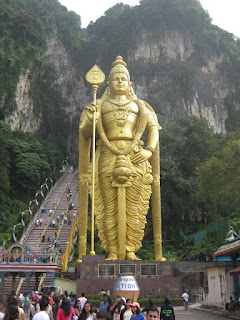
I have given above the view from the pavement of the Hanuman statue & side view of the hills. Once you walk about 100 meters you can have an excellent view of the huge idol of Lord Muruga.

You can see the steps besides the idol, which takes you to Batu Caves. You can find Lots of Pigeons in the court yard in front of idol of Lord Muruga. Please do not carry plastic bags, since they will be snatched by the monkeys on the steps. Some monkeys even bite & harm you. Always move in a group when you are climbing upstairs. There are about 400 steps to reach the top. I have given the photos of the entrance to Batu caves below


The temple of Lord Muruga is located inside the caves. Since some renovations works were going during the time i visited ( October 2015), lot of construction materials were scattered hither & thither. 


You can find shops selling souvenirs near the entrance arch of the Batu caves too. Length of visit can take up to 1 to 2 hrs. 

Thursday, December 17, 2015

Enchanting Kualalumpur

I took the Air Asia flight from Chennai (MAA) to Kualalumpur (KUL). Air Asia flights arrive & depart from KLIA-2, ie, Kualalumpur International Airport 2. It is very far from the heart of the city. The best way to commute is by Skybus. They operate from Basement level of KLIA-2. Once you finish your Customs & Immigration check, you can get down to basement level. A single journey fare from KLIA-2 to KL-Sentral costs Malaysian Ringgit 10 ( RM 10). The journey takes about 45 minutes to 1 hour depending on the traffic. If you are travelling by cab it will cost around RM 80 - RM 100 from KLIA-2 to KL-Sentral.

Once the bus reached KL-Sentral, its just five minutes walk to my hotel located at Jalan Tun Sambandhan. The Nu Sentral Mall, which is a big shopping mall is the connectivity hub those who want to catch KLIA-Ekspress to Airport or KTM-Commuter to Batu caves or KL-Rapid express to other parts of the city.

The mono rail station is also situated just opposite to Nu Sentral Mall, which is located in Jalan Tun Sambandhan. Jalan Tun Sambandhan is full of spicy restaurants of different cuisines. You can find South Indian, North Indian, Chinese & Oriental restaurants side by side.


Wednesday, December 11, 2013

THAI TOURISM MAY BE AFFECTED DUE TO THE CURRENT POLITICAL UNREST

The  current political conflict may affect the Thai tourism industry if the situation is not put under control before the first quarter of next year.
So far, according to official sources there had been no cancellations of air tickets and hotels have been reported among tourists heading to Bangkok and areas with major attractions.
19 countries have issued travel advisories for their citizens to avoid visiting areas near protests in the capital.
The travel warnings came from Britain, France, Sweden, Japan, Taiwan, Canada, Austria, Israel, Brazil, Singapore, Belgium, the Netherlands, Norway, Germany, Hungary, Spain, Finland, Italy and Slovakia. 
                                                    Photo Courtesy :  Ed Wray / Getty Images
But Thailand's King Bhumibol Adulyadej, in an address marking his 86th birthday, called on his people to do their duty "for stability, security of our nation" in an apparent reference to ongoing anti-government protests.

Tuesday, July 30, 2013

VISA ON ARRIVAL : A COMPLETE GUIDE


As you must be aware, Thailand is one of the 20 countries, which provides Visa On Arrival ( VOA ) to Indian passport holders. Once you alight from your aircraft, walk to the visa on arrival desk. (A in the picture given above). You can collect and fill the visa on arrival form. This counter is open 24 hours. You can also choose between regular queue (B) or premium or express queue (C). Additional 200 THB for the premium queue. You can use this option if you are in a hurry to get out. This is practically a waste of money, if more aircraft from India & China, land at the same time & both the queues will be having almost the same no. of passengers. You have to show 10000 Bahts for a single traveller or 20,000 Bahts for a family, as evidence of monetary support during your stay at Thailand. Your travel documents will be checked at (B) or (C ) depending on the queue you choose. The officer there will issue you a token with your number on it. Kindly make sure that you fill the form properly otherwise the visa officer will ask you to start again at the queue. You can relax at the waiting area (D) until your number is called at the immigration desk (E) Once your number is called, proceed to area (E). This is where you will pay the visa fee (1900THB). The office here will paste the visa sticker and stamp the visa. Once It is over, you will find the baggage area just behind the immigration counter(F) You can find lot of taxis & Tuk-Tuks waiting outside Gates 1 - 10, unless you have a reserved accomodation & the transportation is provided by your hotel. You can also avail the Airport Skytrain direct link for arriving at downtown Bangkok.

Saturday, February 18, 2012

GETTING AROUND IN BANGKOK : MY WAY

My First day in Thailand dawned with my arrival at Suvarnabhoomi Airport, Bangkok from Chennai, India. Since I am a bit of explorative guy, I opted to find my own way to Howard Square Boutique hotel, where I had a reservation. Prior to my departure, I had explored the route maps of Bangkok through Google Earth & roughly calculated the distances. It was around 27 kilometers from the Airport to my hotel. I hired a taxi and after a little bit of negotiation, the driver guy settled for 900 Bahts. Similar distance by cab in India would have cost me more than that. I arrived at the Hotel after an hour. The way in which Thai people speak English is little bit different. I have to strain my ears to catch the phrases. Once settled in my room, I started to explore the neighborhood by walk. Howard Square hotel is situated at Bangkna area in Bangkok, which is almost a remote location. The only good thing is, it is having a nice restaurant & bar by name B-Oak in the vicinity. You can get several Indian dishes there. For short distances Motor Cycle Transport is there, wherein you can pay 10 or 15 Bahts for short distances such as 1 or 2 kilometers. Tuk-Tuks are also a better option for short travels in Bangkok, which is also economical. It is really difficult for a vegetarian to survive in Bangkok, since you can find shops selling meat everywhere. You have to survive mainly on Fruits, till you get yourself adapted to Thai Veg food, which in fact is very spicy. Another better option to move around in Bangkok is by Sky Train, where you can get One day pass. You can find the exact fares in my earlier posts. Some hotels offer the free cab drop to the nearest Sky Train station at specified hours. I will take you through the major attractions and malls in Bangkok in my upcoming posts.

Thursday, January 12, 2012

ANGKORWAT - ARCHITECTURAL MARVEL

ANGKORWAT - HISTORY The Temple of Angkor Wat was dedicated to the Hindu God Vishnu by King Suryavarman II, who reigned between AD 1131 and 1150. The Temple was constructed over a period of 30 years, and illustrates some of the most beautiful examples of Khmer and Hindu art. Covering an area of about 81 hectares, the complex consists of five towers, which are presently shown on the Cambodian national flag. These towers are believed to represent the five peaks of Mount Meru, the Home of Gods and Center of the Hindu Universe. Angkor Wat features the ancient Hindu Architecture in the world, which runs along the outer gallery walls, narrating stories from Hindu Mythology. Located about 7 km away from Siem Reap, the Angkor Wat Temple rises out of the ground like a big mountain. Ad measuring about 200 meters each side of a square at the base, the temple is surrounded by a huge moat which must be at least a mile long on each side. It is in an area of Cambodia where there is an important group of ancient structures. It is the southernmost of Angkor's main sites. The initial design and construction of the temple took place in the first half of the 12th century, during the reign of Suryavarman II (ruled 1113 – c. 1150). Dedicated to Shiva, it was built as the king's state temple and capital city. As neither the foundation stela nor any contemporary inscriptions referring to the temple have been found, its original name is unknown, but it may have been known as Vrah Vishnu-lok ( literally "Holy Vishnu'-Location'", Old Khmer' Cl. Sanskrit). after the presiding deity. Work seems to have ended shortly after the king's death, leaving some of the bas-relief decoration unfinished. In 1177, approximately 27 years after the death of Suryavarman II, Angkor was sacked by the Chams, the traditional enemies of the Khmer. Thereafter the empire was restored by a new king, Jayavarman VII, who established a new capital and state temple Angkor Thom and the Bayon respectively) a few kilometres to the north. Henri Mouhot popularised the temple in the west in the mid 19th-century. In the late 13th century, Angkor Wat gradually moved from Hindu to Theravada Buddhist use, which continues to the present day. Angkor Wat is unusual among the Angkor temples in that although it was somewhat neglected after the 16th century it was never completely abandoned, its preservation being due in part to the fact that its moat also provided some protection from encroachment by the jungle.

Saturday, January 7, 2012

HINDU GODS OF BANGKOK

Erawan Shrine : Erawan is the name of the mythical Hindu elephant which was Rama's mount. This is the name of a Hindu Shrine depicting the image of Phra Phrom. It is also a Brahmin Shrine. Similar four headed gold plated images of Rama can be seen often in Thailand particularly out side large hotel buildings. This is not to be confused with the Thai Spirit Houses also often placed in front of buildings. The Trimurthy Shrine : This shrine includes the three pillars of Hindu Gods, Brahma the Creator, Shiva the Destroyer and Vishnu the Preserver. The image is in bronze and is gold plated. Narayana on Garuda : There is a statue of Narayana astride Garuda in front of Intercontinental Hotel, Bangkok. Mahalakshmi Statue : At Bangkok's Gaysorn Plaza, and you have an interesting view from there over the sky train construction, and surrounding building such as the Central World Plaza. Thai people pray to Lakshmi for wealth, although this is the only shrine which is well hidden.

Wednesday, December 21, 2011

CHIANG RAI, SUKHOTHAI & THAI HOLIDAYS 2012

CHIANG RAI HISTORY : King Meng Rai, a friend of King Ramkhamhaeng (1279-1299) of the Sukhothai Kingdom of Thailand, established Chiang Rai in 1262 A.D. near the Kok River. Thirty-four years later, he founded Chiang Mai as a capital city and centre of the Lanna Thai Kingdom (circa 1262-1558 A.D). Thus the two towns have had brotherly relations for a long time. The Lanna Thai Kingdom covered the area of Chiang Mai, Chaing Rai, Phayao,Nan and other provinces in the North of Thailand at present. The kingdom became a Burmese colony from 1558 to 1774 A.D. But finally, King Taksin (1767-1782 A.D.), the king of Siam of the Thonburi period, won it back from the Burmese, and the Lanna Thai Kingdom became a dependency of Siam (former name of Thailand). And Chiang Rai was ruled as a frontier town until 1933 when it became a province of Siam. SUKHOTHAI HISTORY : Sukhothai (427 km), the first capital of the Thai Kingdom, is well-known for its two historic sites . Sukhothai and Si Satchanalai Historical Parks, which have been declared World Heritage Sites by UNESCO in 1991. Tak (426 km) This mountainous province is ideal for nature lovers and adventurous tourists as there are numerous places for white-water rafting, trekking and elephant riding. Blessed with high mountains and natural beauty, Phetchabun (346 km) is where the scenic Nam Nao National Park and Phu Hin Rong Kla National Park are situated. It is also rich with waterfalls, rivers and lakes. Phitsanulok (377 km) features many historic sites and natural scenic spots like Chat Trakan and Thung Salaeng Luang national parks. The province is also famous for the Khek River which is excellent for shooting the rapids. THAI HOLIDAYS & OBSERVANCES 2012 : 1 Jan New Year's Day 2 Jan 'New Year's Eve' observed 23 Jan Chinese Lunar New Year's Day 24 Jan Second day of Chinese Lunar New Year 25 Jan Third day of Chinese Lunar New Year 7 Mar Makha Bucha 6 Apr Chakri Day 13 Apr Songkran 14 Apr Songkran 15 Apr Songkran 16 Apr Songkran observed 17 Apr Songkran observed 5 May Coronation Day 7 May 'Coronation Day' observed 4 Jun Visakha Bucha 1 Jul Mid Year Bank Holiday 2 Jul 'Mid Year Bank Holiday' observed 2 Aug Asalha Bucha 12 Aug The Queen's Birthday 12 Aug Mother's Day 13 Aug 'The Queen's Birthday' observed 13 Aug 'Mother's Day' observed 23 Oct Chulalongkorn Day 5 Dec The King's Birthday 5 Dec Father's Day 10 Dec Constitution Day 24 Dec Christmas Eve 25 Dec Christmas Day 31 Dec New Year's Eve

Tuesday, December 20, 2011

Royal Flora Ratchaphruek Fair

The International Horticultural Exposition or known as the Royal Flora Ratchaphruek Fair is aimed to mark and celebrate the three auspicious occasions - HM King Bhumibol Adulyadej’s 84th birthday anniversary in 2011, Queen Sirikit’s 80th birthday anniversary and Crown Prince Maha Vajiralongkorn’s 60 birthday anniversary in 2012. There will be grand-scale celebrations. Activities are divided into three parts, which are exhibitions about agriculture and the royal agricultural projects, national and international agricultural conferences, and the plant contests. Highlights of the Royal Flora Ratchaphruek Fair include the Giant Flora Wheel, Imagination Light Gardens and Kids’ Eco Park. The over 40-meter high Giant Flora Wheel allows visitors to enjoy the panoramic view of the entire park. Like being transformed by magic, the Imagination Light Gardens, festooned with millions of lights and luminous butterflies dancing around to the accompaniment of music, will spur the imagination and awaken the inner child in visitors. The Kid’s Eco Park features exhibitions and fun activities about global warming to help create the nature loving generations. The Royal Park Ratchaphruek occupies 80 hectares of land in Mae Hia district in the provincial town of Chiang Mai. It is only 8 kilometers from the airport and has ample parking spaces. In such a vast area of beautiful landscape nestling amidst the evergreen mountains, the park boasts thousands of species of tropical plants and flowers. Moreover, there will be more than 30 countries around the world that will join up by demonstrating their horticultural excellence at the expo. Tickets can be bought at the expo at 200 Baht for adults and 100 Baht for children. A 50% discount is offered for advanced purchase at booths outside the royal park (from 1 August - 31 October 2011). The admission is free for senior citizens and children under 100-cm tall. For further details please contact the Information Center of the International Horticultural Exposition at Tel: +66 2 610 2011 (every day from 08.30-19.30 hrs.)

Saturday, December 17, 2011

Bangkok Skytrain, Metro & Airport Rail Link


AIRPORT RAIN LINK :

Suvarnabhumi Airport Rail Link started its official operation since August 2010. The 28.6 km journey from Bangkok to the international airport is completed well under 30 minutes.

The services have 2 lines, non-stop Express services and City Train services. Both lines operate from 06.00 am. – midnight.

Non-stop Express services start at Suvarnabhumi Airport and terminate at Makkasan Station. The journey takes only 15 minutes and runs every 30 minutes. City Train or Commuter services run between Suvarnabhumi Airport, stop at Lat Krabang, Ban Thup Chang, Hua Mak, Makkasan, Ratchaprarop and Phaya Thai. The journey takes 27 minutes and runs every 15 minutes.

Facilitating the tourists and commuters to travel to other parts of Bangkok, both lines have interchange station at Makkasan Station for MRT (Underground train) at Phetchaburi Station. City Train line is linked at Phaya Thai station for BTS (Skytrain) Phaya Thai Station.

Saturday, December 10, 2011

TRANSPORT OPTIONS IN BANGKOK

Bangkok Sky train :

The BTS is undoubtedly the swiftest way to get around, and can whisk you right where you want to be in no time at all. It's a cheap, smooth, cool, clean, fast and scenic way to enjoy Bangkok. Major shopping malls, Chatuchak Weekend Market, all Sukhumvit Road's attractions, and even the riverside are accessible by Skytrain.
While the Silom line runs west to south, the Sukhumvit line runs north to east. So, if you're new to Bangkok, it's a great way to find your way around and see a large part of what the city has to offer. Note that Service runs between 06:30 and midnight, and the trains can be packed during peak hours (07:00 - 09:00 and 16:00 - 19:00)

Fares and Sky train Passes:


Fares start at 15 baht per one stop. A one-day pass may be a good option for those planning to do a lot of hopping on and off for one full day. But if you plan to be in Bangkok for a while, it might be a good idea to buy the BTS Smart Pass.
One-day Pass Unlimited travel within the duration of a single day for 120 baht. Ideal for tourists.

Smart Pass / Stored Value Cards :

These are available for 100 baht plus 30 baht refundable deposit. They are valid for 5 years and can be filled with a minimum of 100 baht and up to 2,000 baht.

30-Day Pass for Adults :

- For 15 trips (use within 30 days), 23 baht per trip unlimited distance, it costs 345 baht.
- For 25 trips (use within 30 days), 22 baht per trip unlimited distance, it costs 550 baht.
- For 35 trips (use within 30 days), 21 baht per trip unlimited distance, it costs 735 baht.
- For 40 trips (use within 30 days), 20 baht per trip unlimited distance, it costs 900 baht.

The following stations offer facilities (such as elevators) for disabled people: Mo Chit, Siam, Asok, On Nut and Chong Nonsi. BTS Tourist Information Centers can be found at Siam, Nana and Saphan Taksin stations. A very informative BTS city map can be picked up free from any station.


Bangkok Underground (MRT):

Fast and efficient, the Mass Rapid Transit network (MRT) has been a welcome and well-used addition to Bangkok's public transport network since its hi-tech doors sprung open back in July 2004.

With a capacity to whiz 40,000 passengers per hour in each direction, trains every five minutes in peak times (07:00 - 09:00, 16:00 - 19:00) and every seven minutes at other times, its responsible (along with the Skytrain) for taking much of the pressure off the city's notoriously clogged roads.

With air-conditioning throughout, it's comfortable as well as quick, and there's also mobile phone coverage - very handy!

Although additional lines and extensions are in the pipeline (pending government approval), it currently only comprises the blue line. This serves 18 stations and stretches for 20 km in a horseshoe shape from Hualamphong in the South (near Chinatown) to Bang Sue in the north. Stops of particular interest to visitors include Chatuchak Weekend Market, Thailand Cultural Centre, Queen Sirikit National Convention Centre, Lumpini Park, Silom and Sukhumvit Road. It intersects with the Skytrain (BTS) at Silom and Sukhumvit stations, from where it's a short walk to BTS Sala Daeng and BTS Asok stations, respectively.

Service is staggeringly efficient; 99.54% of trains arrive on time (source: Bangkok Metro Quality Service Report, 2006), and there is a wide range of tickets available. Customers can purchase single journey tickets from vending machines, or stored value cards from the ticket offices.

A single journey ticket from one end to the other costs 39 baht, taking an estimated 25 minutes (minimum fare for one stop is 15 baht). An unlimited use one-day pass costs 120 baht, a three-day pass is 230 baht, and a 30-day pass will set you back 800 baht.

Parking is provided at seven stations: Sam Yan, Sukhumvit, Phetchaburi, Thailand Cultural Centre, Huai Khwang, Ratchadaphisek and Kamphaeng Phet.

All stations have facilities (lifts) for disabled people.

Before setting off, there are a few peculiarities worth knowing:

- If you want to go to Lumpini Park, do not get off at Lumpini Station. Exit at Silom Station.

- If you want to go to Central Lad Phrao, do not get off at Lad Phrao Station. Exit at Phaholyothin Station.

- If you want to go to Chatuchak Market, do not get off at Chatuchak Park Station. Exit at Kamphaeng Phet Station.

- If you want to go to Thailand Cultural Center, you will need to get a taxi from the station. The Thailand Cultural Centre is a fair distance from Thailand Cultural Centre Station.

TRAVEL BY BUS :

Buses in Bangkok provide an incredibly cheap way to travel from one side of the city to another. It's also a great way to see the real Bangkok you don't often see if you're traveling by other means of transportation. Although buses give you a ringside seat to experience and observe the locals and the city, they're not the most favourite means of getting around. Obnoxious drivers, aggressive bus conductors, bad traffic, pollution and sweaty fellow passengers are some of the things you will inevitably encounter. But this is real, hardcore Bangkok.

The Bangkok Mass Transit Authority (BMTA), under the jurisdiction of the Ministry of Transport and Communications, is responsible for providing bus services to people living and working in Bangkok and nearby provinces (Nonthaburi, Pathum Thani, Samut Sakhon, Samut Prakan and Nakhon Pathom). BMTA operates over 100 routes, served by more than 3,000 buses (regular buses and air-conditioned). There are also privately-owned buses, and minibuses (both private and operated by the BMTA).

Types of Buses & Fares

There are many types of buses available in Bangkok. Bus routes are very extensive too, and can be mind-boggling to first-timers. Make sure you first equip yourself with the MBTA map (available at most bus terminals). When in doubt, ask a local, or policemen, or call the '184' BMTA Hotline for assistance. Most buses (except for the all-night ones) run from 05:00 to 23:00 daily. Regular buses cost 7 baht (cream-red), and 8 baht (white-blue). Expressway buses costs 8.5 baht. Air-conditioned buses (cream-blue) cost from 9 to 19 baht (depending on the distance travelled). All-night buses (cream-red) are 8 baht. EURO II buses (yellow-orange) cost anything between 12 to 22 baht, depending on the distance travelled.


Useful tips

Since destinations on the majority of the city's buses are written in Thai, the best way for visitors to figure out which bus goes where is by the bus number, the type of bus and its colours. The BMTA bus map also comes in very handy. Don't be fooled by the buses with the same number but different colours; they don't always share the same route. Make sure you stick to the numbers that match the colours only. Things to keep in mind when taking a bus in Bangkok:

- The fare will be collected on the bus by the bus conductor.
- Prepare small change for the fare. A 100-baht note on an air-con bus is acceptable, but not so much on regular or smaller buses (500 and 1,000 baht notes are a big no-no).
- Keep the small receipt because sometimes it will be checked.
- On air-con buses, fares vary according to the distance. Just tell the bus conductor where you wish to get off, and he will tell you how much the journey will cost.
- On regular or smaller buses, the fare (around 7 - 8 baht, normally no more than 10 baht) is usually fixed.
- Be courteous and offer seats to small children, monks, the elderly and pregnant women.
- Once on the bus, keep walking inside. Don't stand at the door, or block the way in the middle of the bus.
- Make sure you hold on to the rail at all times because buses tend to be a bit 'jerky'.
- To alert the driver that you want to get off, press a buzzer in advance (before the bus reaches your stop).
- If you're not sure where to get off, ask the bus conductor to let you know.
- Always keep the name of your hotel and its address (or wherever you're staying) with you, preferably in Thai, in case you get lost.
- The newest, most efficient, and spacious bus is of the EURO II (yellow-orange). The drivers and conductors are nice and polite and, most importantly, the air-con works!


Motorbike Taxis in Bangkok

Indeed, one of the fastest ways to get around town when you're a solitary traveller is to jump on a motorbike taxi. By being able to dodge the almost constant gridlock and dart in and out between cars and buses, motorbikes are a quick way to get around, especially during rush hours. Considering Bangkok's notorious traffic conditions, it is probably also the most dangerous!

Despite the immediate hazards - fearless motorbike taxi drivers will do anything to get you to your destination quickly, even if it means driving on sidewalks or in the opposing traffic lane! - many brave passengers opt for the two-wheeled vehicles to take them all over town.

Motorbike taxi drivers are easily recognized. Wearing numbered orange vests, groups of motorbike drivers can be spotted congregating in groups near street corners of office or shopping buildings, busy roads, smaller 'sois' (streets), and near Skytrain and underground stations. Fares will start from 10 baht for short journeys, and varies depending on how far you go. For certain routes, the fare will be fixed, and you'll sometimes see a board displaying prices. But make sure you negotiate prior to the journey, or else you might find yourself paying more than the locals. Always wear a safety helmet - not only for obvious reasons, but because foreigners are easy targets for spot fines (up to 1,000 baht, depending on the mood of the traffic officer).


Tuk-tuks in Bangkok ( Auto Rickshaws):


Tuk-tuks or 'sam lor' (three-wheeled) used to be everyone's favourite way of getting around Bangkok before the BTS, MRT and colourful taxis took over. Originating from an old-fashioned rickshaw during the second World War, a tuk-tuk is essentially a rickshaw with a small engine fitted in.

Tuk-tuks have become one of Bangkok's most recognisable transportation features, and are still popular among tourists and visitors. Riding a tuk-tuk is more of an experience rather than a practical way to get around. So, if it's your first time in The Big Mango, there's no harm in giving it a go. Here are some tips to keep in mind before you wave one down:

- Fares vary, depending on the distance travelled, the time of the day, the traffic, and the mood of the drivers. Normally a very short trip will cost 30 baht.
- Fare negotiating and haggling is a must because the price named by the driver is always an 'inflated rate' (especially if you're a tourist). The trick is to negotiate 5 - 15 baht off the proposed fare, and take it from there.
- Be careful of the 'mafia' tuk-tuks around touristy areas, who often boasts privileged knowledge of 'secret' or 'special' shopping places and things. Some of them may offer sightseeing tours and unsolicited help to take you places. A short and sweet "no, thanks" will save you from their scams. The same rule applies to taxis.
- Avoid taking a tuk-tuk during peak hours (07:00 - 09:00, 16:00 - 19:00). You don't want to be stuck in traffic for hours, sweating and breathing in the hazardous fumes from engines all around you.
- Tuk-tuks are most ideal for short trips. (Sometimes it would cost the same, or even cheaper, to take a cab to the same destination.

Friday, December 9, 2011

TOURIST ATTRACTIONS IN & AROUND BANGKOK

You blog. You Profit. Sign up for SocialSpark!


Down town Bangkok - One full day tour :

1. Grand Palace + Emerald Buddha temple(called as Wat Phra Kaew in Thai)

2. Golden Buddha Temple (solid 5 tons weight)

3. Reclined Buddha Temple (Known as Wat Pho - Giant size Buddha in sleeping posture)

4. Vimanmek Teak wood palace.

South East Subu rb of Bangkok - Around 40Km. from Down town - One full day tour

1. Crocodile Farm - With more than 40,000crocodiles supposed to be the biggest in Asia or world?

2. Ancient City - In a vast land area they made all replicas of Thai temples, Pagodas & Palaces etc. in a pleasant atmosphere which is worth going around. Even there is a small floating market there and number of Chinese kind of temples & palaces too. There is an unbelievable massive size Govardhana giri + Vasuki Cobra structure used by those Demons & Devas together in Milk sea where they were trying to get number of things out of it as per Hindu mythology.

South West Suburb of Bangkok - One full day tour which is not sufficient to cover

1. Floating market(around 100km from down town) It is a small villange with all back water canals around in which all houses are loated on the banks of the canal and every house has normally got a boat in front to commute around. There is a central market place(fresh vegetable,meat) where they still do their buying of goods from the vendors who are also coming on their boats and we can also go around in the boats there.

2. Wax Museum(around 50Km. from down town) As good like the famous one in UK so worth seeing.

3. Rose Garden(around 50Km. in the same location of Wax museum) Very nice Garden where they do have a Thai cultural & heritage show.

4. Buddhamonthon(around 45km. in the same location of Rose Garden) A huge garden where in the middle there is a standing Buddha statue(approx. 60ft. tall) in the open area.

North & North east Suburb of BKK

1. Dream world - Amusement park only(One full or half day depending upon how many rides you want to go)

2. Safari world - There are two areas here one is Open zoo where we could drive through the animals and the other one is with the famous dolphin show, bird show & number of other shows and so one full day to cover for sure.

3. Siam Park - Amusement park with a water park too.

Other than the above there are number of shopping complexes and market places as you know also. In case of you want to go for places away from Bangkok like Ayuthaya(Historic important place), Pattaya(famous night life place at beach), Kanchanaburi(famous River Kwai, water falls and water dam), Huahin(famous beach) etc., they are all around 1 hour to 2 hours distance from Bangkok.

Apart from that visiting Chiangmai & other provinces you can go through the famous websites of Tourism Authority of Thailand where you can get enough information.

If you want to travel by train, you can also get information from the respective websites. In side Bangkok city, the suburban trains like elevated train & underground trains are well operated and latest in all terms but the normal trains running between cities around the country is not even up to the level of our country since it is meter gauge and single line and so it takes lot of time to travel - not much of frequency also. The major problem is language where you will find it difficult to manage if you are travelling alone, you need to be really adventurous type to do this way.

Anyhow it is up to you to decide & confirm all issues and let me know further.

I can book you in a hotel of 3-4 star level(Hotel Windsor, Sukhumvit Soi 20) in the down town area where just in 50m distance there are few of our South & North Indian restaurants - room rent is around US $75/-

In case of you need any other assistance, You are most welcome.

Protected by Copyscape DMCA Takedown Notice Violation Search